Memos
Random interesting stuff I found on the internet.
-
- The Camino de Santiago, a medieval pilgrimage in northern Spain, has a way of making things seem normal that, elsewhere, might make a reasonable person wonder if you’re OK.
- The various routes that converge in the city of Santiago de Compostela began as pilgrimages a millennium ago, when the Catholic Church offered indulgences to those who visited what the church believes is the tomb of St. James the Apostle. (The Camino de Santiago translates to the Way of St. James.) The treks flourished throughout the Middle Ages, faded, then rebounded from a niche spiritual journey to a global escape hatch; in 2025, the pilgrim office handed out 530,000 certificates of completion, or compostelas.
- One of the best things about the Camino is that people can join it at different points—walking a weekend here, a week there.
- Medieval pilgrims may have had faith; I had lightweight REI clothing, moleskin, Hokas and retinol.

- The Camino isn’t wilderness, and it isn’t tourism in the usual sense. It’s a mix of woodland trails and roads following a chain of yellow arrows on stone walls or sidewalks. It’s church bells; bunk beds in 15-euro hostels; and some grand cities but also lots of tiny towns that exist because people with backpacks keep arriving.
- After 500 miles, 26 days, 14 blisters, 18 top bunks, 39 cervezas and a constellation of bedbug bites on my stomach: the cathedral in Santiago.
- I started by following the stages as laid out in the guidebook—there are about 33 of them, which meant walking 15 or so miles a day—but I kept arriving too early. So I began pushing farther: 20-mile days, then 24, then, one day, over a marathon. The Camino is a choose-your-own-adventure: Sleep in public dorms or private rooms, walk solo or in informal groups, carry everything or send your bag ahead.
- The Camino had room for all of us: veterans on their umpteenth Camino, first-timers, and pilgrims carrying very 2026 reasons—burnout, career panic, grief, retirement, faith, escape.
- People often appeared, walked beside me for a while and then disappeared back into the road; I walked for 40 minutes with an 82-year-old on his 17th Camino, who then left me in his dust. But some people aren’t temporary. A Swedish woman and I are planning a European adventure next summer. Our only rule: No walking.
- In this tiny town, I saw what the Camino offered every day: something old and strange and communal and meaningful, remade every night by whoever happened to arrive before the 10 p.m. curfew.
 wsj.com
 -
- Mitsubishi Motors will release a new electric vehicle for Australia and New Zealand this year, to be built by the automotive arm of Taiwan’s Foxconn group.
- This will mark the first time that a subsidiary of Foxconn – formally Hon Hai Precision Industry – builds an EV for a Japanese automaker.
- Mitsubishi Motors expects demand for EVs to grow in the longer term. It has set an initial sales target of 1,500 units in the two countries by the end of fiscal 2026.
- The ASX VR-e is based on a compact sport utility vehicle designed by Foxtron, with adjustments to the headlights, wheels, suspension and other components for local roads.
 asia.nikkei.com
 -
 economist.com
 -
- Across the OECD, a club of mostly rich countries, the productivity of small and medium-size enterprises (SMEs) averages just two-thirds that of large firms. A country’s firm-level labour productivity moves almost one-for-one with its GDP per person. This suggests that a country does not get rich off the back of small businesses. Instead, it has to create an environment in which those firms can get big—requiring robust property rights, functioning capital markets and a government free from corruption.
economist.com -
- In 2018, for example, it began publishing a new monthly gauge of urban unemployment, based, like similar statistics elsewhere, on surveys of the population. But unlike other countries’ figures, China’s measure has remained remarkably stable. July’s rate of 5.2%, published on August 17th, was typical. It was less than 6% but at least 5% for the 99th time in the past 115 months. Even during the covid-19 pandemic, when American unemployment climbed well into double digits, China’s measure never exceeded 6.2%.
- The stability of the unemployment rate is thus a false comfort. It makes it needlessly difficult to interpret the biggest job market in the world. Some economists suspect that China’s export boom is not generating equally strong manufacturing employment. Others think artificial intelligence may be killing some entry-level white-collar jobs. Another worry is that wage growth is not strong enough to stop the economy falling back into deflation. All these suspicions would be easier to verify or dismiss if China’s unemployment figures were as fluid as its economy.
economist.com -
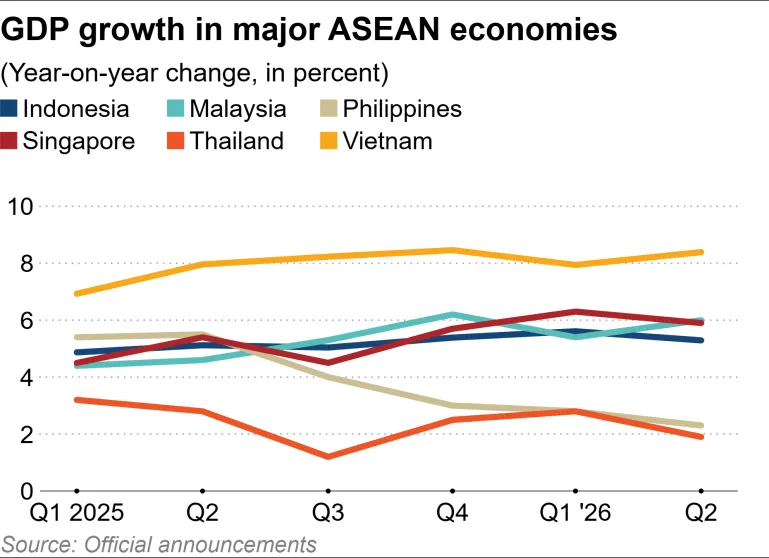
- Thailand’s economy expanded 1.9% in the April-June quarter from a year earlier, according to official data released on Monday, slowing from 2.8% growth in the previous quarter as higher energy prices weighed on consumption and the conflict in the Middle East disrupted travel.
- Thailand follows Southeast Asian peers Indonesia, the Philippines and Singapore in reporting weaker second-quarter growth, underscoring how the U.S.-Iran war, which broke out in late February, is impacting the region.
asia.nikkei.com -
- Chinese sales of EVs, plug-in hybrids and other new energy vehicles grew roughly 30% last year to 16.49 million units, according to the China Association of Automobile Manufacturers. EVs sales rose 38% to 10.62 million and accounted for 31% of total auto sales, up 6 percentage points from 2024.
- But these figures include exports, a key growth driver. Domestic sales of new energy vehicles rose more slowly, climbing 20% to 13.87 million.
- BYD remained head and shoulders above other Chinese automakers in terms of EV sales, with a 23% market share based on factory deliveries, data from MarkLines shows. Geely Automobile ranked second at 13%, followed by SAIC Motor at 12%.
- Overall domestic auto sales, including gasoline-powered vehicles, sank 21% on the year in the first half of 2026, while new energy vehicles slid 13%.
- Automakers are trying to ride out the slump with new models, but their earnings are under strain.
- 542 models had been released from January to May, for an average of 3.6 per day – the same pace that people eat meals. This figure appears to include gasoline-powered models
- “Even if you invest 1 billion yuan ($149 million) on one model and spend two years or more on development, the peak [of sales] doesn’t last even three months,”
- BYD’s new vehicle sales in January to June shrank 16% on the year to 1.8 million units – the first decline for the half in six years. Sales of passenger EVs fell 15% to 860,000.
- Great Wall projects a roughly 60% drop in first-half net profit, while midsize player Seres Group, which makes the Aito brand with Huawei Technologies, expects to post a net loss. State-owned Guangzhou Automobile Group (GAC) sees its losses widening. Besides the intense competition, the rising cost of batteries and semiconductors is weighing on profits.
- Some expect the slump to last.
- China’s auto market may be at a crossroads, but EV growth is expected to continue. In early July, the Chinese government unveiled a plan to raise the share of new energy vehicles among owned vehicles to 30% by 2030, up from 13% at the end of June.
- new energy vehicles will probably account for more than 70% of new vehicle sales in 2030.
asia.nikkei.com -
- DSA’s most recent membership survey, which found that 77 percent of members were white and that more than 80 percent of members 25 years or older held at least an undergraduate degree.
- a revolution powered largely by disaffected, college-educated people, many of whom are comparatively well-off.
- called these voters Subaru socialists: degree holders who have enough money to afford, say, mid-level cars and meals at nice restaurants but who may not own a home or feel fully secure.
- Why are so many “privileged” Americans drawn to a politics that seeks to dismantle the system that they have benefited from?
- A CBS News/YouGov poll released this month found that Democrats, who belong to a party dominated by the professional class, were almost twice as likely to view socialism favorably (58 percent) as they were to view capitalism favorably (32 percent). Among college-educated Democrats, support for socialism was 71 percent.
- the PMC’s current tilt toward the left is unprecedented in American history. Through the mid-2000s, college-educated voters were more likely to be Republicans than Democrats.
- What is notable about the 21st-century PMC, then, is that the type of people who are tasked with championing capitalism to the public have lost their faith. Many members of today’s professional class are apostates, and this apostasy is worth taking seriously as a sign of an economic order that cannot seem to justify itself to its own public-relations arm. When a middle manager at a tobacco company refuses to smoke cigarettes, or a technology CEO sends his children to screen-free schools, or an employee in the meatpacking industry turns vegetarian, many people understand these choices to be the result not only of hypocrisy but also of insider insight.
- A teacher who has to buy his own school supplies, an adjunct professor who works at three universities to make ends meet, a social worker who assists the disadvantaged, a nurse whose hospital was bought by private equity, a federal employee who watches lobbying groups kneecap safety regulations, a data engineer who helps make a product that gives teens suicide advice, a student who takes out burdensome loans to get a degree that is no longer a guaranteed ticket to a middle-class life—what should these people think of capitalism as it currently exists? What do you expect them to think? And why is it considered hypocrisy, rather than a defensible moral position, when some members of the PMC decide that the ugliness they encounter in their workplace, corporate office, and daily life is symptomatic of a system that deserves significant, even systemic, reform?
- many professional-class socialists are no doubt making an earnest moral judgment, born of firsthand experience, that contemporary capitalism is deeply flawed.
- A political lesson could be learned from Mamdani, who, with his smart suits and easy eloquence, makes no effort to hide his social position or fancy liberal-arts degree. Rather than elevating leaders who pretend to be working-class, socialists and left-leaning populists might be better off unapologetically presenting themselves as what many of them are: worried, frustrated, and often justifiably angry members of the educated professional class.
 theatlantic.com
 -
- In Vietnam’s highly centralized system, the new status is expected to give the two localities a more direct channel to Hanoi, potentially smoothing decisions on infrastructure and investment.
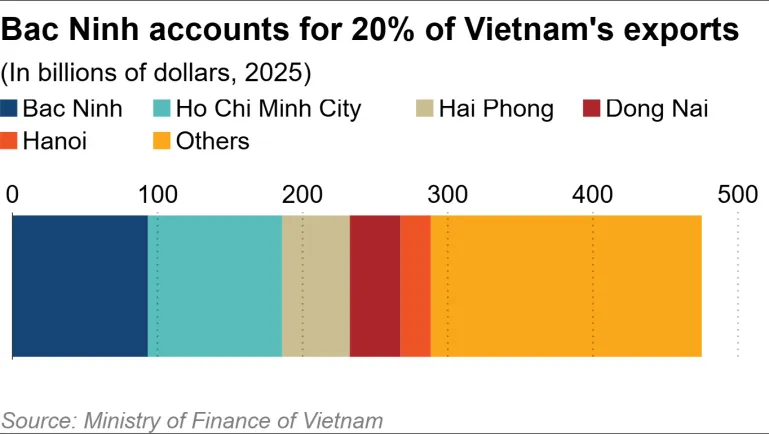
- Bac Ninh was Vietnam’s biggest exporting locality in 2025, with shipments of about $93 billion, accounting for nearly one-fifth of Vietnam’s exports, largely driven by electronics and other manufactured goods.
- The province was also the country’s second-largest FDI recipient last year, attracting nearly 41 billion.
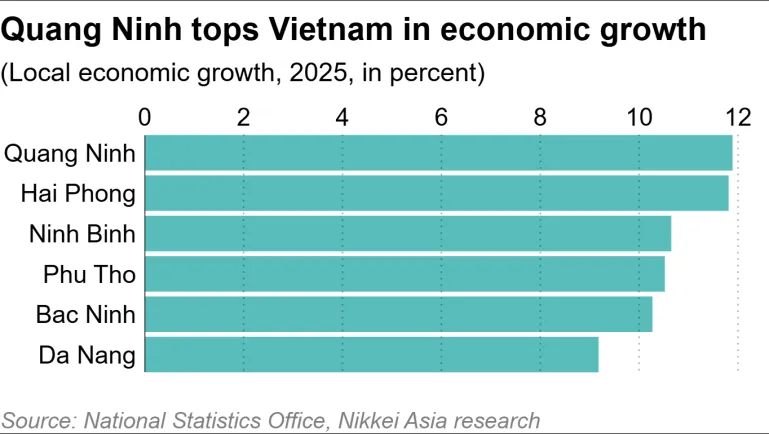
- Quang Ninh, meanwhile, combines tourism, trade and a rapidly expanding manufacturing base. The province recorded Vietnam’s fastest economic growth last year at 11.9%, underscoring its emergence as one of the country’s most dynamic economies.
- Vietnam’s move to elevate Bac Ninh and Quang Ninh has parallels with China, which offers both a model and a warning, said Ascentium’s Forster.
- Shenzhen and Chongqing show how administrative reforms, industrial policy and government backing can help accelerate growth when backed by strong economic fundamentals. Meanwhile, Tianjin offers the opposite lesson, where debt-fueled development without a strong industrial base led to weak growth and empty skyscrapers.
- “Bac Ninh and Quang Ninh look much more like the Chongqing model than the Tianjin one,” Forster said. “The fundamentals are real, the upgrade formalizes and accelerates rather than invents. I’d watch the Gia Binh airport development in Bac Ninh specifically as the next big catalyst.”
- Quang Ninh had the country’s fifth-highest average income last year, at about 6.9 million dong ($263) a month, according to data from the National Statistics Office.
- Bac Ninh’s economy grew 10.27% last year, and its average income stood at around 6 million a month, roughly the national average.
asia.nikkei.com -
- Google has been aggressively expanding capacity in Vietnam and India to lower its dependency on China in recent years, though a significant portion of its production remains in the country. The successful development and production of high-end Pixel phones in Vietnam this year – which is more complicated than smartwatches and earbuds – gave Google the confidence to proceed with the 2027 timeline for moving all Pixel production out of China, sources with direct knowledge of the matter said.
- If realized, the move would make Google the second global brand after Samsung to decouple its smartphone production from China.
- “Compared with Apple, Google has no burden [to leave China] as it does not sell Pixel phones in the Chinese market,” said one of the people with knowledge of the plan. “The progress in Vietnam is smooth, as Samsung has built a smartphone supply chain ecosystem there that Google could also access.”
asia.nikkei.com -
- The growth of the semiconductor industry in Southeast Asia has reconfigured economic development in the region, putting Vietnam and the Philippines on course toward the sought-after status of “high-income countries.”
- Vietnam has lifted its national income through export-led economic growth. It has concluded trade agreements with countries and regions around the world, drawn foreign investment, and established manufacturing hubs for electronic components and electrical equipment.
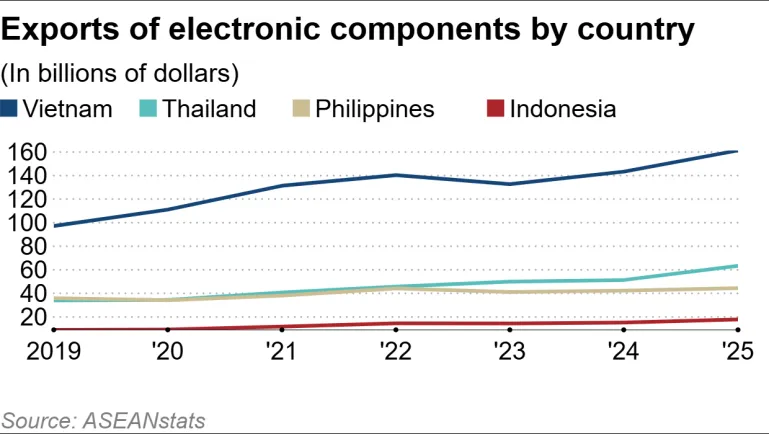
- In addition to back-end chipmaking processes requiring a large workforce, Vietnam looks to engage in front-end processes, which involve circuit formation. Chip design and development will also be part of the effort.
- If Vietnam continues to grow at the same pace as its average over the past decade, then its per-capita GNI will surpass Thailand’s in 2037, and Vietnam will become a high-income country around 2040, according to an estimate in Thai news outlet The Nation.
- The Philippines is also overhauling its semiconductor industry, which centers on back-end processes. In April, it joined the U.S.-led Pax Silica initiative, which aims to build an AI chip supply chain among friendly countries. Semiconductors and other electronic products account for more than 50% of the country’s goods exports by value.
asia.nikkei.com -
- Travel agents often go above and beyond for their clients. That is in part why people still use them in an age of AI-tineraries. In Britain about a third of travellers booked their holidays through a human specialist last year, reckons ABTA, a British trade association. Across the pond more than 310,000 agents are members of the American Society of Travel Advisers, another trade group, up from 190,000 in 2024. LinkedIn recently ranked the job one of the fastest-growing in America (though the Bureau of Labour Statistics reckons it will grow more slowly than average in the period until 2034).
- People turn to travel advisers for their “taste and judgment” in curating trips, says Evan Frank, co-founder of Fora, a luxury host agency. Seasoned advisers have superior knowledge of particular countries and a network of exclusive hotels. Some stick to a particular niche, booking trips for people who have food allergies or tourists who want to travel solo or with their pets.
economist.com -
- Israeli settlers have planted vines in neat rows, erected fences festooned with flags and brought in herds of goats. They patrol the area with new Ranger utility vehicles and assault rifles given to them by the Israeli government.
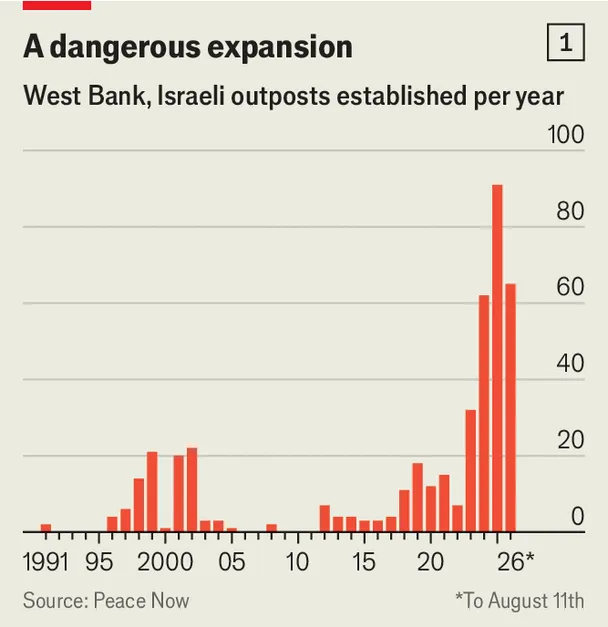
Chart: The Economist
- Their stated aim is to cause “friction” with adjacent Palestinian villages. That tends to lead to intervention by the Israel Defence Forces (IDF), more often than not on the settlers’ side, followed by the expulsion of Palestinians and the expansion of outposts of Israeli settlements (see chart 1).
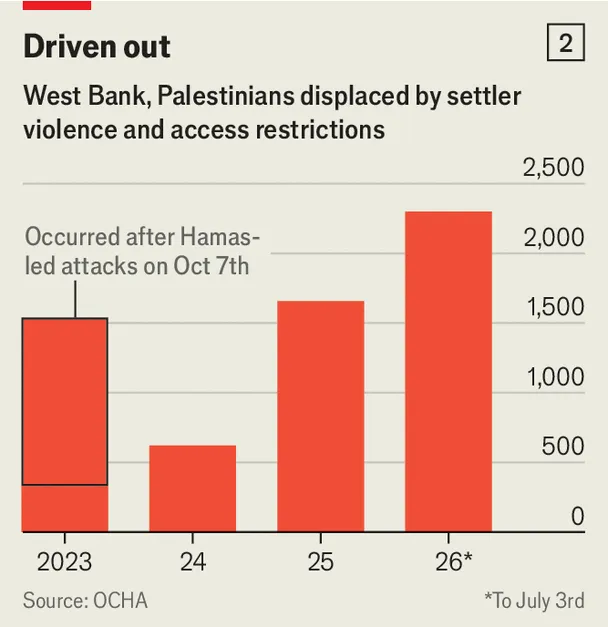
Chart: The Economist
- The tactic, common in the West Bank, often succeeds at forcing Palestinian villagers to flee their homes, allowing the settlers to take over the surrounding land. This time was different for several reasons. The residents of Qusra, who had previously experienced similar attacks, were quick to publicise the latest one online and attract international attention. One of the besieged homes is owned by an American citizen. Mike Huckabee, the American ambassador, who usually supports the settlers, posted on social media that it was his embassy’s “request to remove the Israeli terrorists”.
- Yet the incident is also part of a fresh escalation over the past month, as settlers have tried to grab as much land as they can before the election in October, which might return a government less supportive of their cause.
- On July 24th a group of armed settlers arrived in the village of Tel on what they claimed was a “hike.” Four Palestinians and two Israelis ended up killed. In response the IDF deployed more troops and imposed closures on Palestinian towns, including Nablus, one of the largest cities in the West Bank.
economist.com -
- Israel should be killing “30 to 40” people each night in Gaza and should build Jewish settlements in the Palestinian enclave, the country’s far-right national security minister has said in an interview.
- Ben-Gvir also called for the re-establishment of Jewish settlements in the Palestinian territory, saying that he envisaged “all Gaza” belonging to Israel, and reiterating his previous calls for Palestinians to “emigrate”.
- During Hamas’s October 7 attack, militants killed 1,200 people, according to Israeli officials, and took more than 250 hostages to Gaza where they were kept in harsh conditions, with many saying they suffered abuse in captivity.
- Israel responded with a ferocious offensive in Gaza, which has killed more than 73,000 people, according to Palestinian officials, and caused a humanitarian catastrophe in the enclave. This includes 1,200 people killed since a ceasefire took effect last October.
- Ben-Gvir’s statements are the latest in a string of inflammatory rhetoric from the far-right minister, who oversees the Israeli police and prison system.
-
- Even in the most remote corner of China a frothy Fulujia beer is waiting for you. The company, whose name translates as “Lucky Deer”, has opened more than 3,200 mini-pubs across the country since 2021, making it the world’s largest bar chain. More impressive than its scale are its prices. A pint is poured for as little as 5.9 yuan ($0.87), whether it is served in a big city or a border town.
- Fulujia premises are small but uniform micro-watering holes that have 20 beers on draft and a bijou seating area. They often sell bar snacks such as fried pork and edamame beans. When asked why prices are so low, the proprietor of a recently opened Fulujia in Lushui, a town in the deep south-west, says it is because the company is owned by Mixue Bingcheng, a tea and cold-drinks mega-chain that has around 60,000 outlets worldwide. Last year it overtook McDonald’s, the American burger giant, to become the world’s largest fast-food operator by number of locations.
- The secret to Mixue’s success is its mastery of supply chains. It is often described as a logistics company rather than a fast-food chain. The efficiency with which Mixue has been able to move supplies has kept costs for consumers remarkably low—its marquee drink is a four-yuan lemonade. Fulujia uses the same logistics networks to ship its beer from Henan province, where both Mixue and Fulujia are based, to its franchisees, who do not pay transport costs, even when they are as far away as Lushui, more than 2,000km from the brewery.
- Nearly two-thirds of its 3,200 bars have been launched since Mixue bought its stake late last year.
economist.com -
- Between February and June, China slashed its crude imports by half, or 5.5m b/d—enough, experts reckon, to have shaved $30 or more off Brent, the global benchmark. That is more than half of the worldwide decline during the covid-19 lockdowns, when global demand collapsed by 9m b/d. And in contrast to the pandemic, when the world economy slid into recession, China’s GDP has chugged along just fine.
- This ability to turn oil demand on and off, ostensibly at low economic cost, allows the world’s biggest oil importer to move prices just as the Organisation of the Petroleum Exporting Countries (OPEC) and its allies have long done through their control of half of global output.
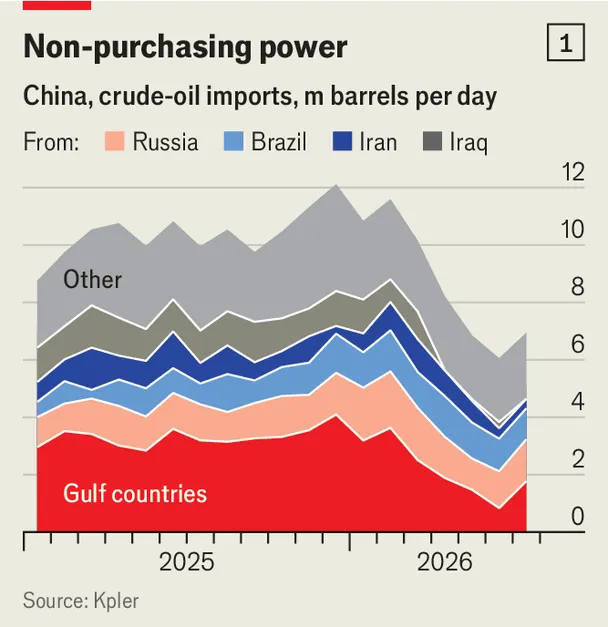
Chart: The Economist
- For four decades OPEC has striven to keep prices high using production quotas. Importers cannot conversely keep prices low by rationing demand, because buyers are much more fragmented than sellers and because domestic energy demand is the result of decisions by countless agents. Huge, statist China is the exception. And unlike OPEC+, whose decisions require agreement among 21 countries, its central planners can act unilaterally on the orders of one man, President Xi Jinping.
- China moves petroleum markets using three main levers. The first is its national petroleum stocks. In the 12 months to early 2026, as the spectre of a “superglut” depressed crude prices, China snapped up 200m barrels on the cheap, topping up already ample reserves of 1bn barrels. Traders reckon Chinese purchases may have added $10-20 to the global price of a barrel before the Iran war broke out. Of the 11.6m b/d China imported in February, up to 1m b/d were excess purchases it could subsequently forgo by stockpiling less.
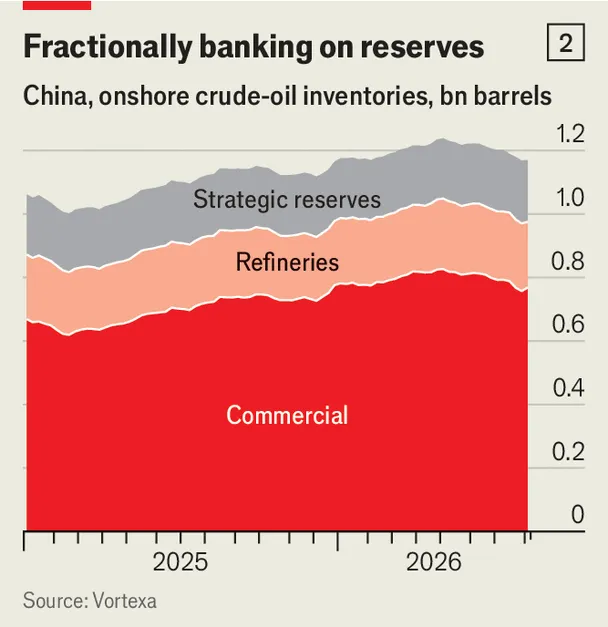
Chart: The Economist
- Once its last pre-war Gulf cargoes had arrived in late April, China began drawing down these brimming reserves. By July its inventories had fallen by 70m barrels, according to Vortexa, a data firm, not counting draws from floating storage and hidden caves. Add these in, and China tapped 150m barrels in those three months, or some 1.5m b/d.
- Commercial stocks—held by the profit-seeking storage arms of big oil firms—rather than strategic reserves accounted for most of this. Refiners must usually replace what they draw within a month, notes Tom Reed of Argus Media, a price-reporting agency. But since those firms are state-owned, and the state can requisition commercial stock, an exemption was presumably made.
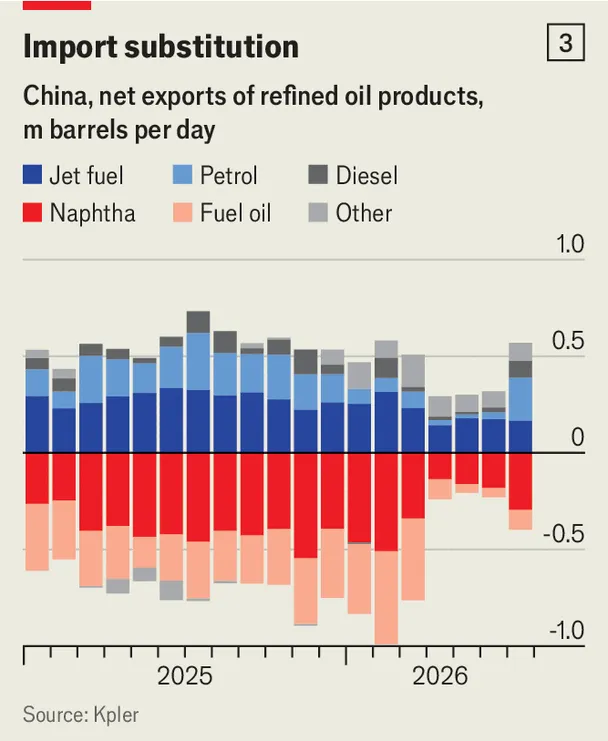
Chart: The Economist
- Chinese central planners’ second lever is export controls. As the world’s second-largest oil refiner, China is usually a big fuel supplier to its Asian neighbours. In March, however, the government ordered domestic refiners to stop signing new export contracts and unwind many of those already agreed. Between February and April, China’s exports of refined products fell by nearly half to 430,000 b/d. This included 180,000 b/d of highly refined jet fuel, which saved Chinese refineries 1.2m-1.8m b/d of crude.
- The Chinese government also pulled a third lever—curbing domestic demand. In June Chinese refineries processed 2.7m fewer b/d of crude than a year earlier. Production of petrol fell by 14%; output of diesel and jet fuel both shrunk by 21%.
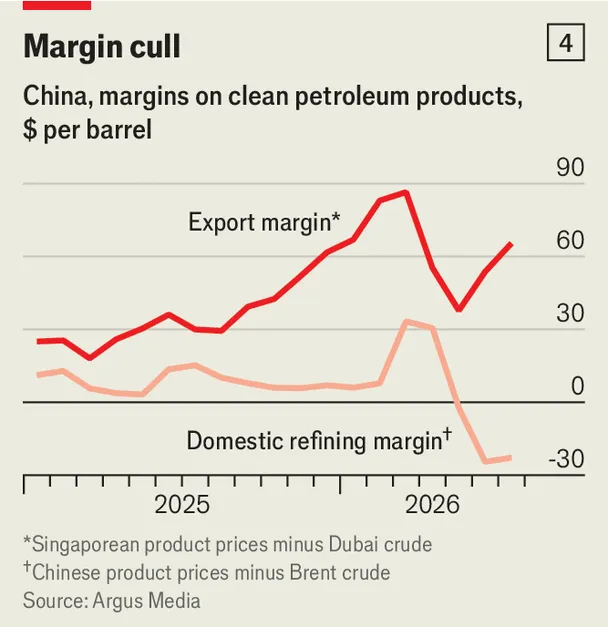
Chart: The Economist
- A look under the bonnet confirms a sharp drop in Chinese motor-fuel use. As the authorities allowed fuel prices to rise, many city dwellers have stopped driving to work, opting instead for the metro, bicycles or taxis (many of which are battery-powered). During a week-long national holiday in May, electric-vehicle charging along motorways rose by nearly 55% compared with the year before. Trains are picking up the slack from domestic flights, the number of which has been slashed. Local authorities have postponed infrastructure works, saving on diesel. Ciarán Healy of the International Energy Agency reckons China burnt 10% less petrol and kerosene in the war’s first couple of months than in the same period a year earlier.
- China’s petrochemical industry, the world’s biggest, is also adapting to the straitened circumstances. Last year it turned millions of barrels per day of naphtha and LPG, a lot from the Gulf, into polymers—materials ranging from PVC and synthetic rubber to nylon and polyester—which Chinese factories use by the tonne. In the absence of Gulf-sourced feedstocks, and in the presence of a government edict to prioritise fuel over feedstocks, petrochemicals firms have instead come up with ways to make some polymers using coal and ethane, a gaseous byproduct of petroleum refining.
- Years of state-backed investment in renewables and green transport has made the energy system more flexible. Years of “involution”, where fierce competition has led to overcapacity in industries including petrochemicals, has left China with large unsold inventories of polymers and the stuff these go into.
- Such buffers explain why producer prices are not spiking and consumer prices remain under control.
economist.com -
-
THE GREAT economic surprise of the Iran war has been that oil prices have stayed relatively contained even with the Strait of Hormuz mostly shut. Five months into the war Brent crude remains about 126 per barrel intraday high it hit on April 30th; for a while there was even a “mini-glut” of crude oil. As a result motorists and oil importers have not yet faced a severe crunch.
-
When Iran started pointing its drones and missiles at tankers crossing the strait, 14m barrels per day (b/d) of crude oil—roughly one-fifth of world output—risked being trapped in the Gulf. Saudi Arabia and the United Arab Emirates (UAE) soon redirected about 5m b/d via pipelines. Strategic-stock releases by rich countries, including America and Japan, covered another chunk. But the biggest shock absorber has been a near-halving of China’s crude-oil imports, to 5.5m b/d. Curtailing China’s imports has been a feat of state engineering, achieved by releasing stocks, restricting exports and managing demand.
-
China’s oil strategy, by contrast, has proved helpful this year. Its accumulation of vast stocks when prices were low will have imposed a small cost on the global economy at the time. But dampening price spikes is correspondingly beneficial. If China ends up smoothing peaks and troughs in prices, it could make investments in new sources of supply easier to plan. Trying to buy low and sell high can go wrong, as any speculator knows. Thankfully it is China that bears that risk, and the costs of storage.
-
Yet over time the supply of oil may contract faster than demand, and China’s role in influencing the latter could shrink. Every two years, as oilfields deplete, the world loses one Saudi Arabia’s worth of crude supply. At a global level, investment is inadequate to replace those barrels beyond 2030.
economist.com -
-
-
PROLONGED SITTING rightly has a bad rap. A review in 2012 concluded that the most sedentary were more than twice as likely as the least to have or develop diabetes, and also faced a much higher risk of premature death. Another, in 2015, found that sitting for long stretches was associated with “deleterious health outcomes regardless of physical activity”. Three years after that an analysis of news articles in the British Journal of Sports Medicine found hundreds of pieces that referred to claims likening sitting to smoking.
-
An analysis in 2018 found standing at a desk burned just nine more calories per hour than sitting. Nor are the cardiovascular gains impressive.
-
A review in 2020 pooled nine trials involving 877 people. Participants stood about 1.3 hours more a day and were followed for roughly four months. Body fat and blood-sugar control improved slightly, but blood pressure, insulin, cholesterol and triglycerides did not. The study did not, however, look at blood flow and the activation of postural muscles, both factors which might contribute to the benefits of standing over sitting.
-
standing can have downsides. A study in the International Journal of Epidemiology in 2024 crunched data on 83,013 adults in Britain followed for an average of nearly seven years. Those who stood for more than two hours a day had a higher risk of varicose veins and venous ulcers, perhaps because of pooling of blood in the legs.
-
What matters far more is movement. A study of nearly 482,000 Taiwanese adults in 2024 found that just 15–30 minutes of extra daily exercise could erase most of the excess mortality risk associated with sitting at work.
-
20 adults perform short reading and typing tasks on an ordinary chair, an exercise ball and a seat mounted on top of an inflatable bladder. Energy expenditure on the ball was similar to normal sitting. But on the bladder, participants’ heart rates and calorie burn rose by 6–13% and 19–40% respectively. Writing in Ergonomics in 2019, the researchers attributed this to muscle contractions required to maintain balance.
economist.com -
-
-
Surging food and utility costs continue to squeeze margins for his izakaya Japanese-style pub, and profits have not recovered as quickly as customer traffic has since the COVID-19 pandemic.
-
Its signature dish is straw-seared bonito sourced from Tokyo’s Toyosu wholesale market. The fish is grilled and served with ginger and green onions. Nearly every customer orders it, Matsubara says.
-
But the wholesale price of bonito has risen three to four times over the past two to three years. “If we raise prices much further, people will stop ordering it,” he said.
-
According to Tokyo Shoko Research (TSR), 118 izakaya operators went bankrupt during the first half of 2026, the highest January-June total since comparable records began in 1989. More than 90% of the failed businesses employed fewer than 10 people. It also forecasts the total number of izakaya bankruptcies in 2026 could reach a record high.
-
Changing drinking habits are adding to the pressure. Kuranosuke’s Matsubara feels that corporate drinking parties have largely returned since the pandemic, but second and third rounds of drinks – once a staple of Japan’s after-work culture – are far less common, meaning less revenue during late-night hours.
-
According to Japanese research firm Fuji Keizai group, the market size of izakaya-style and robatayaki charcoal-grilled foods is expected to be 1.1 trillion yen in 2035, down 31% from 2019.
-
as inflation squeezes household budgets, diners are becoming more particular about where they spend their money.
-
For years, customers were drawn by low prices, locations near train stations and all-you-can-drink plans. Today, many seek something more distinctive: signature dishes, local sake, memorable service and unique atmospheres.
-
The cramped setting leaves little room for anonymity. Customers find themselves drawn into conversations with the owner and often with strangers seated nearby.
asia.nikkei.com -
-
-
The common perception is that they are cheap and that even the best persistently lag behind America’s. In fact, the two countries’ AI models are converging. Innovative Chinese models are getting bigger and cleverer.
-
Although Chinese models are cheaper, American models are often better value. Artificial Analysis, an American firm, finds that for most trade-offs between cost and intelligence, an American model outperforms Chinese ones.
-
China’s open-weight models can run on anyone’s servers, meaning that compute is less of a problem than the headline numbers suggest.
-
China also has almost three times as much installed electricity-generating capacity as America, and its lead is growing.
-
as with other broad technologies such as electricity, adoption brings greater rewards than discovery.
-
China’s working-age population is due to shrink by 25% by 2050; for machines to replace people requires diffusion
-
So far, the use of AI has yet to show up in the economic statistics of either America or China. But change in some industries has already been sweeping. AI-assisted lorries will need 30% fewer drivers, going by one large firm’s experience, as crews slim from two drivers to one and from four to three. AI was used to generate 95% of the 128,000 wildly popular one- or two-minute-long microdramas released in the first quarter of 2026, replacing many actors and film crews.
-
China is also rapidly increasing the use of robots. In June leaders told local governments and state-owned enterprises to have 10,000 humanoid robots doing real work by the end of 2026. Morgan Stanley, a bank, expects humanoid sales in China to reach 446,000 by 2030, nine times this year’s total. Workers are being paid to train robots in huge warehouses by repeatedly folding clothes and sorting and stacking objects.
-
Although Chinese firms want to roll out AI fast, the government will be desperate to avoid instability.
economist.com -